
Liner notes: Side 1
Notes on the first six tracks of Thirteen Paper Moons, an album with words and music by Nick, performed entirely by AI.

Hello and thank you for persevering with this self-indulgence.
Again, this is a post from me (Nick) while fellow traveller (Kate) wanders wearily through Second Novel World.
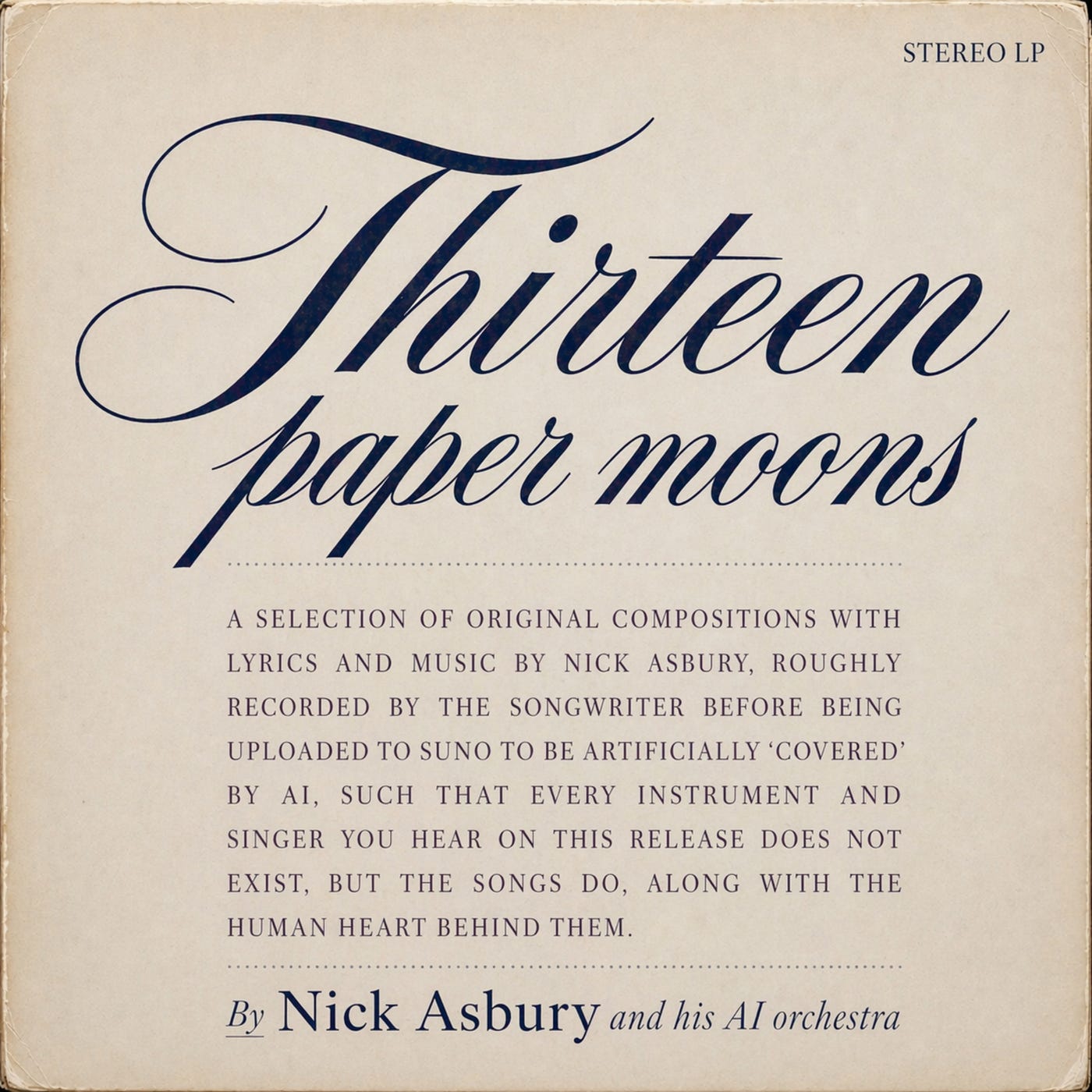
In the last post, I released Thirteen Paper Moons – a collection of Tin Pan Alley-style songs where I write the words and music, record myself playing them, then upload the recordings to a website called Suno and generate ‘cover versions’ by AI. The resulting music consists entirely of singers and musicians who do not exist, but it’s my way of bringing to life songs that would otherwise barely exist either.
For anyone interested, here are a few notes on each of the tracks.
This was the first song Kate and I recorded together. We took a ‘make it weird’ approach and I loved the echoing harmonies in the last verse in particular. But a few lines in the lyrics bugged me (the end of the second verse mainly), and I’ve put that right in this AI version.
I remember writing the song based on the theory that many classic song titles involve what a rock-n-roll grammarian would call ‘temporal adverbials’. Things like ‘From this moment on’, ‘Time after time’, ‘Soon’, ‘Yesterday’, ‘As time goes by’. I decided ‘From time to time’ hadn’t been taken, so used that as a starting point. Later, Kate and I also did a song called ‘Sooner or later’.
Here’s another temporal adverbial 🤘
I’ve discovered adverbial phrases (temporal or otherwise) are useful to songwriters, because you can use them at both the start and end of a verse. Again, this one started with the title and wandered off from there.
Given that this whole thing is a cosplay Tin Pan Alley exercise on my part, I allowed myself to say ‘fall’ instead of ‘autumn’ near the end. This sets up the closing lines: “I’ve seen Paris bring / in the spring, / New England in the fall. / I thought I’d seen it all / til I saw you.” I like the internal-rhyming ‘ings’ in those lines (including the ‘ing’ of Eng-land). It’s often what I’m trying to do with the lyrics: keep it conversational but weave in internal rhymes, assonance and alliteration, so the words have an in-built musicality to them.
NB: it took some delicate prompting to get the AI to deliver the ‘Picchu’ ‘Beats you’ rhyme and it still doesn’t really nail it.
(As I mentioned in the previous post, the AI cover version process is a strange lottery – you can’t edit what it gives you, or ask it to repeat the same again with a minor change. Each generated track is like pulling the lever on a giant slot machine. All you can do is fine-tune the prompt and hope for the best.)
Another song that started with the title. I like finding these idiomatic phrases and seeing where they go.
I find it uncanny how AI can deliver a song like this. When it’s just voice and piano, and when the song is fairly ‘trad’ in nature, there’s less for it to mess up.
This title came from somewhere else. Several years ago, I remember listening to an episode of the Adam Buxton podcast and hearing the guest talk about the sad ‘backwards dance’ that you do when both parties realise a relationship isn’t working. The song unpacks that idea into the standard verse-verse-bridge-verse.
Incidentally, with all these songs, I never write the lyric first, then the music later. Both build themselves at the same time – it’s like the melody is the right foot, and the words are the left and I have to move both in order to keep going forward.
Jeez, another temporal adverbial. Again, this started with the title – taking a familiar figure of speech and trying to make it feel unfamiliar again. More than most songs on this album, I think of this as an ‘exercise’ that maybe doesn’t rise above pastiche. But in my head, I like to imagine pitching it to some hard-nosed publisher in the 1930s, who puffs on a cheap cigar and says “Sure kid, I’ll give you thirty dollars for it.” (I’m a kid in this daydream.)
Finally for now, this is a slightly less ‘Tin Pan Alley’ song. I was going for ‘happy tune, sad words’, which can be effective (also vice versa). I like to think of it as the kind of song Samuel Taylor Coleridge would write if he was reborn as a Nashville troubadour – where the sad singer communes with the rain, first lamenting it but eventually finding salvation in nature.
Side 2 next time. Thanks for reading / listening.
Love hearing about the process Nick.