
Liner notes: Side 2
Notes on the last seven tracks of Thirteen Paper Moons, an album with words and music by Nick, performed entirely by AI.

Following Side 1 earlier this week, here are a few notes relating to the last seven tracks of Thirteen Paper Moons.
For the uninitiated, this is a collection of Tin Pan Alley-style songs where I write the words and music, record myself playing them, then upload the recordings to a website called Suno and generate ‘cover versions’ by AI. The resulting music consists entirely of singers and musicians who do not exist, but it’s my way of bringing to life songs that would otherwise barely exist either.
Before launching into Side 2, a word about AI music in general.
I’m keenly aware of how strange and soulless it is to have songs performed by disembodied algorithms, trained on a body of work that almost certainly involves unpaid artists and copyright infringements. For that reason, I know many people will be against AI music on principle.
For my part, my ethical lodestar is that human creativity is a good thing. Copyright law is a vital way of protecting it, but there are cases where it can limit creativity. In important ways, especially with amateur art that barely registers a blip on the radar, I think the concept of ‘fair use’ is a fair one. If I’ve written original songs and can use this technology to bring them to life, while not directly appropriating anyone’s voice, playing, words or composition, then it feels strange not to use a tool like that – while being honest about its provenance and not pretending it’s the same as the real thing.
There’s also the aesthetic question of whether it simply lacks life and spark. In most cases, that feels true, although it’s also true of some human music. But in some cases, I find it uncanny how sensitively a song can be delivered by this dumb robot.
All this plays into a question Kate and I have returned to in these conversations: to what extent does a song exist as a thing, separate from its performance? If some near-extinction event happened and, for some reason, the only versions of Beatles songs that survived were AI cover versions on a dusty hard drive, and some future civilisation unearthed them, would there not be untold artistic value in that discovery? Not as good as finding the real recordings, but still encoding much of what makes them of value – the lyrics, the melodies, the writing of them?
On some level, that’s how I conceptualise these recordings – putting my songs into some form other than crap recordings of myself singing, and with more life to it than simply releasing sheet music that no one would have much motivation to play, given that I’m neither Beck nor Beethoven. (I always liked that Beck concept of releasing an album purely of sheet music.) My hope is that people can see through the limits of AI performance and find some value in the songs themselves, as things.
Anyway. I had Stephin Merritt / Cole Porter in mind with this one – going for that genre of urbane, literary wit, combined with utter heartbreak. For once, there’s no bridge, just three verses. I feel it has a stately, chamber-music kind of vibe that didn’t need to be broken up, almost like the singer doesn’t have the energy to do so.
Along with ‘One of these days’, I feel this one is more of an ‘exercise’ that ends up closer to pastiche than the other tracks. The lyrics are undeniably pleased with themselves – all clever-clever rhyming (“this devotion, al / -beit notional” 🤓). But I think it’s offset by the naive happiness of the sentiment, and I like the way the melody skips along and builds.
I admire the way the AI delivers this one, strange as that is to write. In some other dimension, I like to think of this song sneaking onto Frank Sinatra’s In the Wee Small Hours of the Morning, and music critics being confused to find out it was written by some twat in northern England.
I’ll be my own hype man on this one – I think it’s good. Musically, I like short songs that don’t overstay their welcome, and I think the melody has a nice lilt, with a bridge that wanders off and circles back neatly. Lyrically, I hope it has that combination of conversational and crafted. For example, the first verse reads as a single sentence that you can imagine someone saying naturally in conversation, but the rhymes happen to fall in the right places. “Rose-tinted blues are the sentimental KIND that make you reminISCE on a time that you MISS that only exISts in your MIND.”
I’ve heard the 32-bar verse-verse-bridge-verse song described as the American sonnet. (At least, I think I’ve heard that – maybe I made it up.) But it’s a good comparison – both lend themselves to a train of thought unfolding naturally, incorporating a bridge/turn before reaching a resolution.
By the way, this is called ‘Rose-tinted blues’ but isn’t a blues song. Blues-tinged maybe, but not blues. I’m convinced this is OK – Bob Dylan does it.
Another song that takes a familiar idiom (going out of my mind) and returns it to its literal meaning. The whole song is someone journeying out their mind and experiencing love as a kind of psychedelic experience. It has one of those intros that you get in old-school songs. And it has a chorus!
This is a strange one – a children’s song in its innocent melody and verses, but a grown-up, world-weary song in the stoical spirit of the refrain. Partly singing to the listener, partly an internal monologue from someone just about clinging on. The AI renders the song faithfully as I recorded it, but the nature of the voice turns it into something more ethereal – it reminds me a little of Imogen Heap, who Kate first switched me onto.
And finally this one – written before any of the other songs, back in around 2011. Short and sweet, about the birth of a (my) child after a period of seeming like it wouldn’t happen. Again, the AI renders it faithfully, complete with a bassline that I roughly included in my recording. Maybe it’s just me and my sentimentality, but I find the performance of this song almost supernaturally good. The piano flourishes towards the end, the tone of the vocal, the general vibe – it’s all exactly what I had in mind, and I like it as a coda to this little collection.
To whomever I’m still talking to, thanks for being interested in all this.
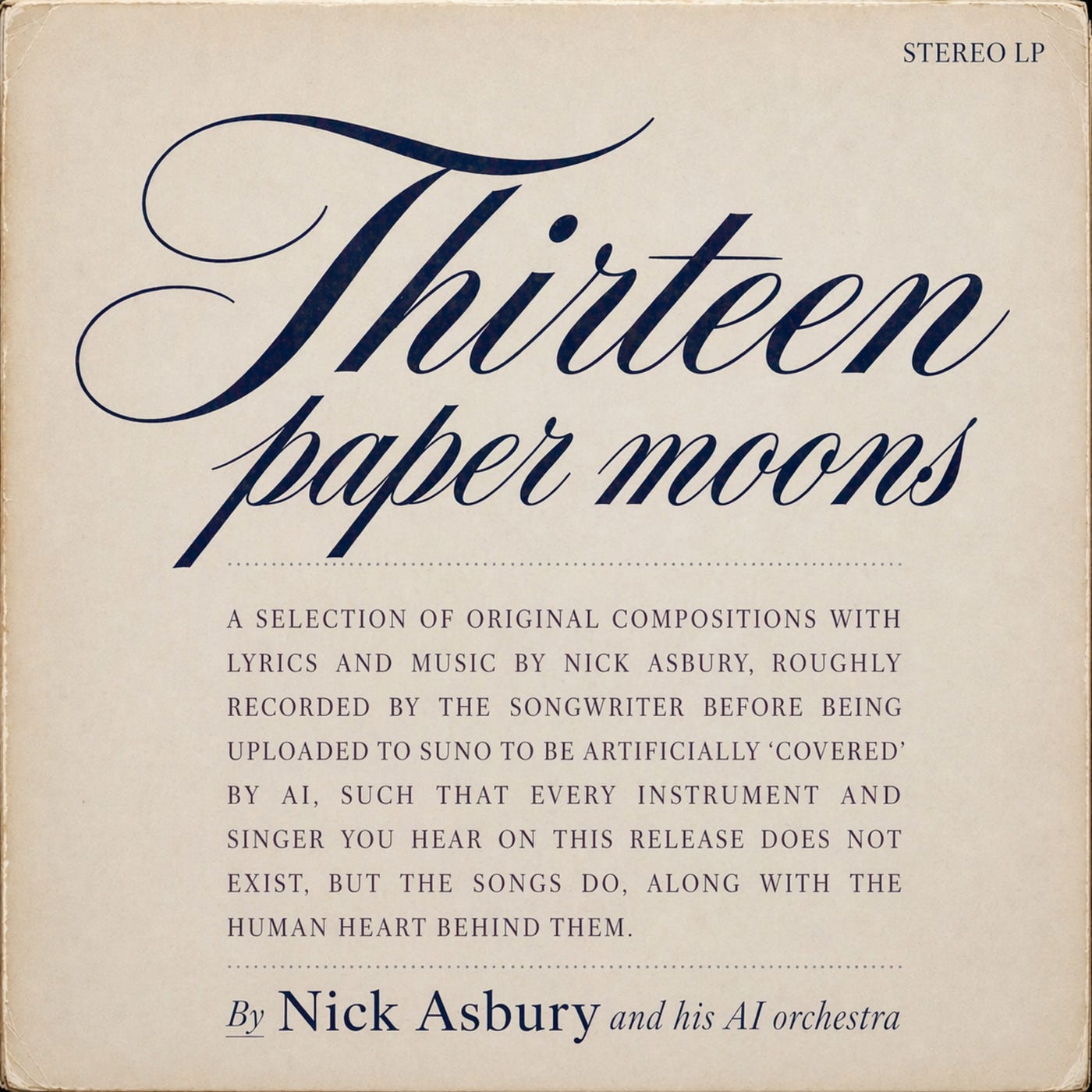
Thirteen Paper Moons is available free on YouTube and nowhere else. Spotify, Soundcloud, Bandcamp and all the others have a policy of no AI-generated music. It’s a policy I understand in the grand scheme of things, even though it’s strange to be in a position of creating something that I feel is wholly me in its essence, but is considered taboo by publishing platforms. Maybe that makes me rock ’n’ roll and edgy, or just even more of a twat from northern England.