
Thirteen Paper Moons
While Kate writes novels, here is a new album by Nick Asbury and his AI orchestra

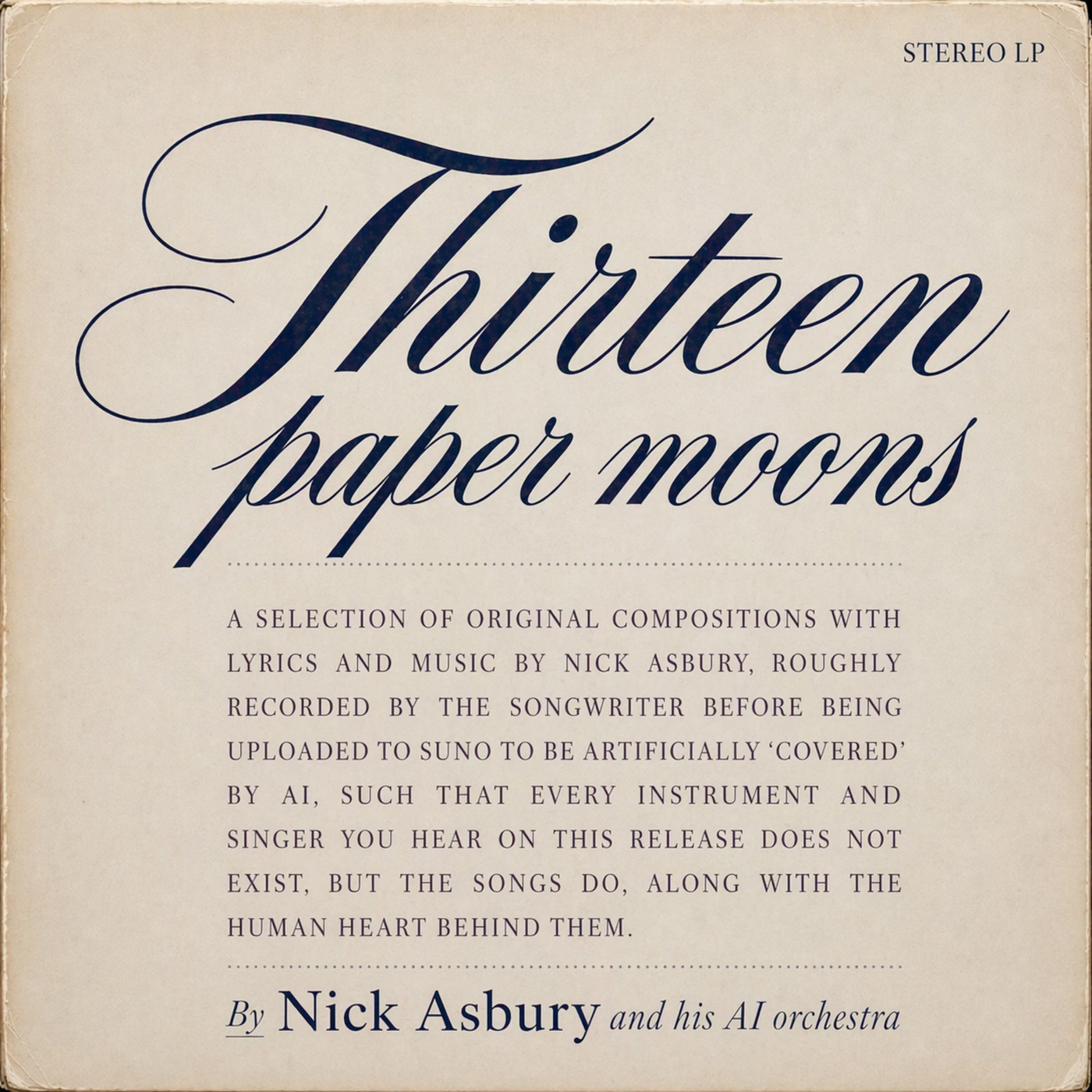
Hello, this is Nick Asbury here. You’ve not received a Songwritings post in a long while, mainly because Kate van der Borgh (co-pilot on this project) has inconsiderately become a successful novelist. And He Shall Appear is now out in paperback, while the Difficult Second Novel is currently in progress. Kate also continues to do other forms of writing and workshopping, so there’s not much room for the slow business of music-making.
In the meantime, here’s something I never expected to be sharing.
Thirteen Paper Moons is a collection of songs written by me and performed by AI. I created the lyrics and melodies, then recorded myself playing them on guitar and piano – these are the kind of recordings I used to send to Kate, which she’d then transform into something else: not just ‘performing’ them, but creatively interpreting them and taking them in new directions.
Thirteen Paper Moons is nothing like that. Instead, I uploaded my recordings to a website called Suno: the musical equivalent of ChatGPT. Having uploaded the recordings, I then asked Suno to ‘cover’ the songs, giving it a guide on style and instrumentation. A couple of minutes later, the songs come back, brought to life by a jazz orchestra, Appalachian folk band, or whatever else you prompt. (Further down in this post, I explain some of the details and limitations.)
It’s a truly unsettling technology – the kind of thing that would have struck Teenage Me as futuristic beyond all comprehension. In many ways, it’s also deeply dismaying and alienating. I’m fully aware of the ethical objections people have to AI in general, especially when it comes into contact with the creative arts. I’ll no doubt write more about this.
But this technology is also a gift to the massed ranks of pale and interesting bedroom songwriters like myself, who enjoy the process of writing songs, but aren’t gifted in performing them, or cut out for the inherently social business of forming bands, or skilled in the technical craft of creating music with GarageBand, LogicPro and other tools.
Many Tin Pan Alley songwriters were like this. Most were not performers, but behind-the-scenes lyricists and composers, who created the songs for others to perform. Irving Berlin was barely an accomplished musician. A self-taught pianist, he could play in only one key, and had a specially-made piano with a ‘transposing’ lever that shifted the internal workings to enable him to play the same notes but have the song come out in a higher or lower key.
I think Irving Berlin would have used the lever of AI without hesitation – at least as a means to an end. It’s a quick way to ‘demo’ a song and get it out into the world. For him, that would have meant a Frank Sinatra or Ella Fitzgerald eventually doing it properly. For me, this is as far as the songs will get – but it’s a way of documenting them in a way that would never otherwise happen.
As readers of Songwritings will know, the obsession round here has always been with Tin Pan Alley. I like its mix of the commercial and romantic, literary and populist. As an apprentice in the trade, I’ve consciously written some songs almost as exercises, so I admit to the charge of ‘pastiche’ that could be applied to some of these songs. But they’re also heartfelt and I’ve put a lot into them. And I think the results lend themselves to a technology like Suno, which is dreadful if you’re trying to create something raw and real like the next ‘Smells Like Teen Spirit’ or ‘Like A Rolling Stone’. But for genre music tied to a specific period, it does a more passable job.
Here’s the track listing – the whole thing is up on YouTube:
00:00 From Time to Time
02:52 Til I Saw You
06:47 Wrack and Ruin
09:57 The Backwards Dance
13:16 One of These Days
15:34 Copycat Rain
19:52 How Original
23:22 Is It Possible?
27:04 Shut Up and Drink
30:45 Rose-Tinted Blues
32:51 I'm Going Out of My Mind for Her
36:34 Caterpillar Song
40:40 For a Boy
Three notes on the production:
First, the results are wayward and hard to control. Having generated the cover version, there’s no way (for me at least) to edit it. If you prompt Suno to do the same again but without the saxophone solo, it’ll come back with an entirely new creation, quite possibly involving a saxophone. Each time you generate a cover version, it’s a roll of the dice. But with the right prompting and a bit of luck, you can generate something workable.
Secondly, the vocals are the hardest part. I find it does female vocals better than male, but I know some will find the delivery cloying in places. Quite rightly, you can’t prompt it to ‘Sing like Ella Fitzgerald’ because referencing any specific artist is out of bounds for copyright reasons. But ‘Female, 1950s jazz/blues light lyrical soprano with warm tone and conversational styling’ might get you close (or might not).
Thirdly, the album cover is a deliberate homage to the cover of Ira Gershwin’s ‘Lyrics on Several Occasions’, which I wrote about on The Book Cover Review. I wrote the text, used the book cover as a prompt, and AI did the rest. This is the world we live in now.
And one final note for long-time Songwritings readers: all these tracks are new, apart from ‘From Time to Time’. Since our original recording, I’ve reworked the lyrics as I was never quite happy with them.
Anyway, off you go, little album. Your title comes from here:
“It’s a Barnum and Bailey world,
just as phony as it can be,
but it wouldn’t be make-believe,
if you believed in me.”
From ‘It’s Only a Paper Moon’
by Yip Harburg and Harold Arlen
These are wonderful. 'Shut up and Drink' is my favourite, but they are all beautifully crafted. Silicon Pan Alley.